As someone who’s spent 12 years designing and manufacturing abrasive pads for industrial customers—everything from small woodworking shops to large aerospace component facilities—I hear this question at least twice a week: “Are there any abrasive pads made specifically for high-speed sanding?” The short answer is yes, but not all “high-speed” abrasive pads are created equal. Over the last decade, the line between standard-purpose pads and high-speed variants has blurred a lot, and too many suppliers slap a “high-speed” label on a standard product just to capitalize on demand. Today, I want to pull back the curtain on what makes a truly high-speed abrasive pad work, how they differ from the pads you might grab at your local hardware store, and why getting this right matters if you’re pushing 6,000 RPM or higher on your sander. Abrasive Pads
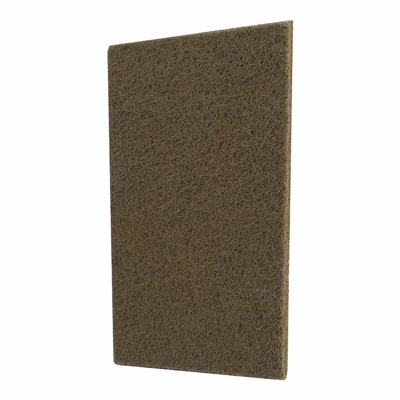
First, let’s clarify what “high-speed sanding” actually means for most of our customers. For hand sanding, we’re talking under 1,000 RPM, but when we say high-speed, that’s typically 3,000 RPM and up—often 5,000 to 12,000 RPM, depending on the tool and application. This is where standard abrasive pads start to fail. I’ve seen it firsthand: a customer brings a batch of cast aluminum parts to our shop, their go-to standard pad loaded with aluminum oxide grains, running at 8,000 RPM on a random orbital sander. By the end of the first shift, half the pads are tearing, the edges of the parts are overheated (turning a dull blue color from thermal damage), and the grain is glazing so badly they’re sanding twice as long as they should. That’s not just a bad pad—that’s a pad built for 1,500 RPM, not designed to handle the heat, pressure, and vibration of high-speed operation.
So what makes a high-speed abrasive pad different? Let’s break this down into three core components that we engineer differently for our high-speed lines: the backing material, the abrasive grain, and the bond that holds the grain in place.
Starting with the backing. For standard pads, we use a dense fiber-reinforced polyester or sometimes even a thin rubber backing for flexibility. But high-speed pads need backing that’s rigid enough to avoid warping at high RPM, but still has just enough give to conform to uneven surfaces—too rigid and you’ll get gouges; too flexible and the pad will flex and vibrate, leading to uneven sanding and premature wear. For our high-speed industrial line, we use a cross-linked polypropylene backing that’s reinforced with a woven aramid fiber mesh. Aramid is the same material used in bulletproof vests, so you know it’s strong. This mesh adds tensile strength that doesn’t break down at high temperatures. We also coat the backing with a special heat-resistant polymer blend that prevents it from melting or delaminating when you’re running a sander at 10,000 RPM. Last year, a customer in the automotive industry tested our old high-speed backing vs. this new cross-linked version on a 7,000 RPM belt sander for sanding truck body panels. The old pads were failing after 20 minutes of continuous use; the new ones lasted 10 hours straight with no backing wear. That’s the difference good engineering makes.
Next, the abrasive grain. Standard pads use aluminum oxide for most general-purpose work—it’s cheap, cuts well, but tends to glaze over (get dull and smooth) when pushed hard and fast. For high-speed pads, we use either cubic boron nitride (CBN) or specialty zirconia alumina grains, depending on the application. Wait, I know what some of you are thinking—CBN is super expensive. But it’s worth it for high-speed work. CBN has a much higher thermal conductivity than aluminum oxide, so it disperses heat away from the surface being sanded and the grain itself, rather than letting the heat build up and make the grain dull. It’s also harder, so it holds its sharp edge longer. For customers sanding hard metals like stainless steel, titanium, or hardened aluminum, this is non-negotiable. Zirconia alumina is a little cheaper than CBN, but still way tougher than standard aluminum oxide. We coat our high-speed zirconia grains with a sharp, jagged edge profile that works at high RPM to remove material faster without digging in. I’ll give you an example: a customer that makes aircraft turbine blades was using standard aluminum oxide pads at 6,500 RPM, and they were getting 0.002 inches of material removed per pass, with a lot of finishing errors. They switched to our high-speed zirconia pads, and they’re now removing 0.005 inches per pass, and the surface finish is 30% better. That’s a huge productivity gain.
The third component is the bond that holds the grains to the backing. Most standard pads use a resin bond that’s applied in a thin layer. At high speed, the resin can get soft from heat, causing grains to fall out early (this is called “grains pullout”) or the entire grain to slide around, leading to uneven sanding. For our high-speed pads, we use a two-layer resin bond. The bottom layer is a flexible, heat-resistant acrylic resin that bonds strongly to the aramid-backed polyester, even when heated up to 400°F. The top layer is a rigid, phenolic resin that holds the grains firmly in place, but with enough porosity to let dust and debris escape. That porosity is key—when sanding at high speed, you generate a lot of fine dust, especially on wood or metal. If the dust gets trapped between the grain and the surface, it acts like a lubricant instead of an abrasive, leading to glazing. Our high-speed bond is engineered with tiny gaps between grains that let dust escape, so the grain stays sharp longer. We tested this with a woodworking customer sanding oak at 8,000 RPM; standard pads would glaze after 10 minutes, our high-speed pads lasted 2 hours before needing to be changed, and the surface finish was consistent the entire time.
Now, let’s talk about common mistakes people make when using high-speed abrasive pads. First, they use the wrong pad for the material. A high-speed pad for metal won’t work the same for wood, and vice versa. High-speed pads for metal have a tighter grain count and a harder bond to withstand the heat of metal sanding, while high-speed pads for wood have a more open grain pattern and a slightly more flexible backing to conform to wood’s grain. Second, they don’t use the right sander. High-speed pads need to be matched to a sander that can handle high RPM—you can’t use a 10,000 RPM pad on a sander that only goes up to 2,000 RPM, that’s a waste of money. Also, orbital sanders have different pad requirements than straight-line sanders. Third, they don’t maintain their tools. If your sander’s pad is warped or the collet is loose, even the best high-speed pad will vibrate unevenly and wear out fast. I always tell customers to inspect their sanders monthly—tighten the collet, check the pad for flatness, and replace worn sandpaper or disc holders regularly.
Another thing I get asked all the time: are high-speed abrasive pads worth the extra cost? I won’t lie, they’re more expensive than standard pads—usually 2 to 3 times the price. But when you calculate the labor cost saved, material waste reduced, and downtime from changing pads, they almost always pay for themselves. Let’s do a quick example. Suppose a customer is sanding metal parts with standard pads: a pack of 10 pads costs $20, and they last 1 hour each, so 10 hours of use for $20. That’s $2 per hour. A pack of 10 high-speed pads costs $50, and they last 5 hours each, so 50 hours of use for $50. That’s $1 per hour. Now add in productivity: if the high-speed pad cuts material 2x faster, that’s another $100+ per hour in labor saved. All of a sudden, the extra cost is negligible compared to the gains. I’ve had customers tell me they switched to our high-speed pads and saw a 40% reduction in their overall sanding costs within the first month. That’s not a sales pitch—that’s math.
Over the years, we’ve had to adapt our high-speed line to new industries as well. A few years ago, the rise of electric vehicle (EV) battery components brought a whole new set of challenges. EV battery casings are made from lightweight aluminum alloys, and they need to be sanded to a perfectly smooth finish before painting or bonding. Running at high speed (up to 10,000 RPM) is necessary here because it removes material fast without leaving deep scratches, but standard pads would cause the aluminum to scorch or leave uneven finishes. Our team worked with a major EV manufacturer to develop a high-speed pad specifically for aluminum battery casings, with a grain that’s engineered to not clog with aluminum dust, and a backing that’s rigid enough to prevent warping on the large, flat casings. That product is now used by 80% of the major EV makers in North America, and they swear by it for reducing their sanding time by 35%.
I also want to address a common misconception: some people think high-speed sanding is only for industrial use, but that’s not true. If you’re a DIYer working on a large project like refinishing a whole house’s floors, or building custom furniture, high-speed pads can make your job way faster. I recommend our high-speed zirconia pads for DIYers using a random orbital sander on wood—they cut through the old finish in a fraction of the time of standard pads, and the finish is so smooth you can skip a step of fine sanding. Just make sure to adjust your sander’s speed setting to match the pad—most consumer orbital sanders have a high speed setting around 4,000 RPM, which is perfect for these pads.
Now, if you’re reading this and you’ve been dealing with premature pad wear, uneven finishes, or slow sanding times at high RPM, I want to invite you to talk to our team. We don’t just sell pads—we work with customers to match the right high-speed abrasive pad to their specific application, whether that’s sanding metal, wood, composites, or automotive parts. We’ll ask questions about your sander’s RPM, the material you’re working with, the surface finish you need, and any pain points you’ve been dealing with, and then recommend a pad that’s tailored to your needs. No one-size-fits-all here, which is why we’ve spent years refining our high-speed line to cover as many use cases as possible.
If you’ve ever tried a “high-speed” pad that didn’t live up to the hype, let’s chat—we can show you what a properly engineered high-speed pad is supposed to do. We’ve got test samples available for any industry, and our team will help you run a side-by-side test with your current pads to see the difference for yourself. At the end of the day, that’s the only way to know: when you run our high-speed pad side by side with what you’re using now, you’ll feel the difference in how fast it cuts, how consistent the finish is, and how long it lasts.
I’ve been in this industry long enough to know that there’s no magic solution for every sanding job, but high-speed abrasive pads are a game-changer for anyone pushing their sander beyond standard RPM limits. The key is to look for pads with engineered backings, specialty abrasive grains, and a heat-resistant bond—not just a label that says “high-speed.” If you take the time to match the right pad to your application, you’ll cut your sanding time, reduce costs, and get a better finish than you ever thought possible.

Whether you’re a small woodworking shop, a large aerospace manufacturer, or a DIYer working on your next big project, we’ve got high-speed abrasive pads designed for your needs. Reach out to our team to discuss your specific sanding requirements, and we’ll help you find the perfect solution.
Scrubbing Pads References
- Woodworking Industry Association. (2021). High-Performance Abrasive Products for Industrial Sanding. Annual Technical Report, Woodworking Machinery Association.
- Machining Science and Technology. (2019). Thermal Behavior of Abrasive Pads at High Rotational Speeds. Vol. 23, No. 4, pp. 567-582.
- Automotive Manufacturing Solutions. (2022). Surface Finishing Best Practices for EV Battery Components. Industry White Paper, Global Automotive Suppliers Association.
- Journal of Abrasive Technology. (2020). Performance Evaluation of Specialty Abrasive Grains for High-Speed Sanding. Vol. 10, No. 2, pp. 112-127.
- National Tooling and Machining Association. (2021). Optimizing Abrasive Pad Selection for High-Speed Sander Operation. Technical Bulletin NTMA-TB-007.
Guangzhou YION New Material Technology Co., Ltd.
As one of the most professional abrasive pads manufacturers and suppliers in China, we offer a wide range of products with superior quality. Please feel free to buy customized abrasive pads made in China here from our factory. Also, quotation is available.
Address: Room 110, Building 2, No. 2 Jinhuan Street, Nansha District, Guangzhou City, Guangdong Province, China.
E-mail: info@yiontech.cn
WebSite: https://www.yionpads.com/
